Heavy Equipment Transport: What Really Goes Into Moving a Machine

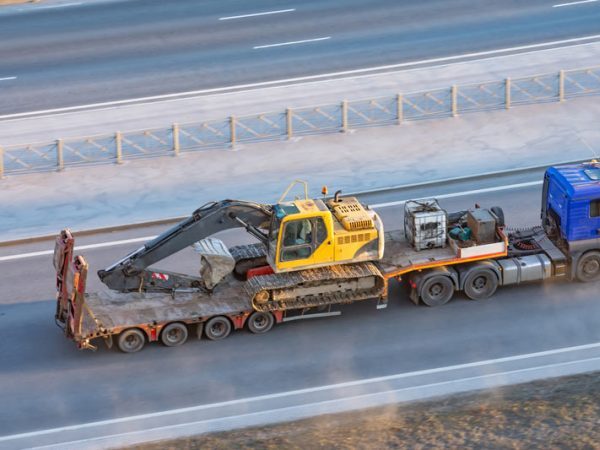
Moving an excavator or a crane is nothing like shipping a pallet. Heavy equipment transport involves weight limits, trailer selection, state permits, and route planning that all have to line up before a truck ever rolls. If you have never arranged one of these moves, the process can feel like a black box. Here is how it actually works.
When your load becomes “oversize”
Federal rules set the baseline for heavy equipment transport on the road without a permit: 8 feet 6 inches wide, 13 feet 6 inches tall, and 80,000 pounds gross vehicle weight. Cross any one of those, and you need a permit from every state your load will pass through. Permits are trip- and route-specific, so approval for one lane does not carry over to another. Loads far past those limits, often above 150,000 pounds, get classified as superloads and can require a route survey and bridge analysis first.
That one detail explains most of the surprises in heavy equipment transport pricing. A machine that stays legal moves cheaply. A machine that needs permits, signage, and pilot cars costs considerably more.
Trailer choice drives everything
The deck under your machine decides whether you clear bridges at all, so trailer selection is the heart of heavy equipment transport.
A standard flatbed sits roughly five feet off the ground and usually carries two or three axles. It handles raw materials and shorter construction vehicles well. A drop deck, also called a step deck, lowers the main surface to about three and a half feet, which buys you height. Double drop and lowboy trailers sit lower still, around 29 inches off the ground, and that clearance is what lets a tall excavator pass under an overpass legally. For the heaviest pieces, nine-axle setups spread weight across more contact points to stay inside bridge limits.
Getting this wrong is expensive. Too tall for your route means rerouting, re-permitting, or breaking the machine down and paying to reassemble it.
What your carrier needs from you
Accurate numbers are not paperwork for its own sake. Four details shape the entire heavy equipment transport plan:
- Weight of the commodity, which determines the vehicle and equipment assigned
- Exact dimensions, which decide the trailer type and permit class
- Pickup location and destination, which shape the route and surface obstacles early
- Type of commodity, since some machines need specialized handling
Guess on weight and the wrong trailer shows up. Guess on height and you find out at a bridge.
Budgeting realistically
Open-deck heavy haul rates in 2026 generally run from about $2.50 to $8.00 per loaded mile, with specialized RGN, lowboy, and multi-axle work sitting near the top of that range. Priced per machine, construction equipment commonly lands between $2,000 and $5,000 per piece. Three things move that number: whether the load is oversize, how far it travels, and insurance, since pricier equipment carries a higher premium. Ask for an itemized invoice so you can see which one is driving your cost.
Tracking matters more than people expect
On a pipeline spread or a phased build, machines have to arrive in sequence. A dozer that lands before the site is graded is a cost, not a delivery. Dependable carriers document every movement, keep proof-of-delivery paperwork on every load, and can pull up load photos when a billing question comes up.
How we handle heavy equipment transport
At Osage Specialized Transport, we have been at this since 1995, under the same 50/50 ownership the whole time, with more than 75 years of combined experience in transportation, operations, and safety. We run a routine fleet of 40 to 50 trucks throughout the continental United States, with capability into Canada and Mexico. Our internal dispatch program lets us track every machine we move, every time we move it, and we help with loading and unloading on site. We have hauled for Caterpillar, John Deere, Komatsu, and Link-Belt dealers, and for the Ruby, Keystone, and Rover pipeline projects.